(🇬🇧)
In Milan, The Blake Works tests both company and audience with its austere logic of movement, revealing skill while withholding warmth and emotional payoff
by Alessandro BIZZOTTO
It almost feels sacrilegious to withhold instant veneration from William Forsythe. But at Teatro alla Scala, in the William Forsythe Evening, The Blake Works unfolds as architecture in motion rather than spectacle, demanding a recalibrated gaze rather than awe. The collision between post‑classical movement and contemporary sound – fragmented, unsettling – remains challenging. Yet here, it finds a distilled coherence: a choreography reined in, sharpened, capable of twisting familiar ballet grammar into something at once austere and alive.
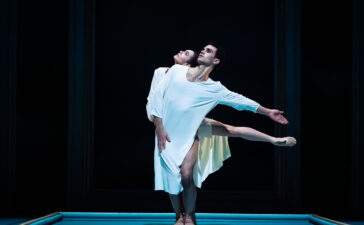
The evening begins with Prologue, a skeletal invocation in which dancers inhabit space like breath hallucinating geometry. Lines stretch, contract, pause; silence becomes weight, bodies become architecture. There is no romanticism, no flourish – only tension, leverage, the body contorting itself into new angles. The effect is visceral, demanding: not a surrender to beauty, but an engagement with form as an instrument of disruption. Yet dancer Francesco Mascia seems able to bring an honest passion to the piece.
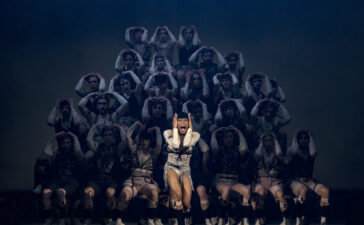
Next, The Barre Project pulls the attention toward a different horizon. The barre becomes anchor and ghost; the music is fractured, minimal, and pulses while the dancers cling, release and oscillate. In this flux, a certain lack of definition emerges. Among the sea of bodies, even La Scala’s principal dancer Nicoletta Manni, with classical polish, seems to dissolve into the mass rather than assert an identity. The choreographic language offers little for a singular light to shine; the presence becomes diffused, delicate, almost apologetic: graceful, but hollow. There’s no villainy in the observation, only the quiet unsettling of expectation.

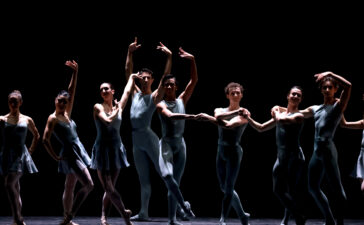
Then arrives Blake Works I, and at last the tension unbends. The ensemble moves as one living organism: rhythms collide and reform, bodies interweave, lines fracture only to reassemble elsewhere. Originally created for the Paris Opera Ballet and set to the melancholic electronics of James Blake, Forsythe’s choreography feeds on speed and density: intricate footwork, sudden directional shifts, elastic torsos. Classical grammar is not discarded but retooled, bent into a kinetic language that feels urgent without becoming overwrought. What emerges is a sustained flow, less concerned with narrative or climax than with the accumulation of energy, a choreography that holds the eye through its relentless coherence. Here, first soloist Marco Agostino navigates Forsythe’s complex vocabulary with quiet command: each line cleaves through space with precision and intent. Soloist Camilla Cerulli emerges with a subtle magnetism: she balances control and vulnerability, giving flesh to Forsythe’s skeletal forms.


The program as a whole has nerve: it refuses comfort and narrative ease. Instead, it draws out a tension between form and feeling, discipline and yearning. At moments, one feels the choreography as a cage. A beautiful, meticulously constructed cage. At others, a sharp vessel: clear, capable of carrying breath. Many have hailed this revival as a significant step for the company, praising how the Milanese dancers inhabit a radically new lexicon of movement, reshaping the familiar into something provocatively alive.
Yet the evening leaves the spectator unsettled. The brilliance is partial and the satisfaction ambivalent. Forsythe does not ask to be loved. He demands to be understood, decanted. The Blake Works does not deliver warmth so much as resolve: clear, cold, exacting. In that precision lies both its deadliness and its vaguely seductive power.
A night of ballet, yes, but of ballet that bites. And in that bite resides both the beauty of thought and the sting of distance.