A ritual of remembrance that alternates between flashes of brilliance and glimpses of the deeper humanity that Carla Fracci embodied
by Alessandro BIZZOTTO
Now in its fifth edition, the Gala Fracci at Teatro alla Scala has established itself as a ritual of remembrance. Conceived as a tribute to Carla Fracci’s artistic legacy, the evening seeks to evoke the values she embodied: integrity, interpretative intelligence and respect for the lineage of classical ballet. The result is a sequence of excerpts where tradition and reinterpretation coexist, not always seamlessly, but often revealingly.
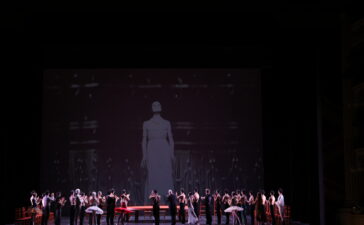
The opening Défilé, set to the March from Wagner’s Tannhäuser, brings together the full breadth of the Scala Ballet and the students of the Academy. It is a courteous and handsomely arranged prologue, warmly received, though its ceremonial ambition inevitably recalls similar moments at the Paris Opera — a comparison that, here, highlights more the dignity than the grandeur of the occasion.
The first pas de deux, from Le Corsaire, places technical bravura front and centre. Mattia Semperboni approaches the choreography with overt virtuoso display, dispatching feats of elevation and turns with emphatic confidence. Yet the execution, however athletic, remains curiously opaque: the phrasing lacks modulation, the presence never quite settles into charisma. Martina Arduino appears under strain in her variation, particularly in the turns, where instability interrupts the line and compromises the overall fluency of her interpretation. The result is competent rather than compelling: an exercise in mechanics more than dialogue.
Mario Pistoni’s Francesca da Rimini, in its brief extract, passes without leaving a strong imprint. Vittoria Valerio and Nicola Del Freo struggle to bring life to the dramaturgical density of the work.
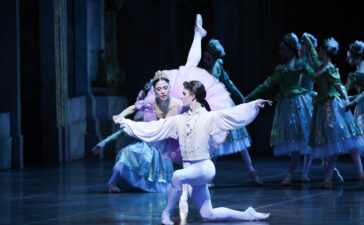
A clearer artistic statement emerges with the Act III excerpt from The Sleeping Beauty. Alice Mariani proves the unquestionable focal point: her Aurora gleams with adamantine brilliance, each step articulated with classical exactitude and an unforced sense of authority. Her dancing sparkles and reassures in equal measure. Opposite her, the Dutch National Ballet’s Jacopo Tissi appears caught at a crossroads of indecision, effort and self-regard. The performance never quite breaks through the surface to claim the space: a Prince elusive in conviction.
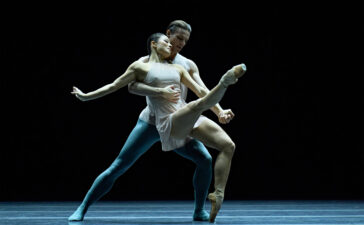
The evening finds its true moral and emotional centre in the pas de deux from Akram Khan’s Giselle. Far from being a mere contemporary insert, this reimagining functions as a modern homage to one of Carla Fracci’s most iconic roles – not through imitation, but through transposition. Stripped of Romantic gauze and narrative ornament, the ballet’s emotional core emerges with startling directness, and it is precisely this clarity that allows the homage to resonate so deeply.

In Marco Agostino, the gala finds an ideal interpreter for such a task. Intelligent, inward and finely attuned to nuance, he carries the choreographic and emotional weight of the piece with rare maturity. His dancing is never demonstrative; instead, it listens, absorbs, reacts. Entrusting this moment to his broad, dependable shoulders proves a quietly inspired choice. Alongside him, Camilla Cerulli meets the challenge with disarming sincerity, her presence restrained yet piercing. Together, they inhabit the grief rather than merely illustrating it. In a programme rich in virtuosity, Giselle stands apart as the one excerpt that truly dares to move.
In the mirror pas de deux from Onegin, John Cranko’s choreography retains its inexhaustible emotional potential, yet the excerpt format proves unforgiving. Nicoletta Manni approaches Tatiana with an unexpected coolness: the surface controlled, but the emotional temperature carefully regulated. What should tremble hesitates to melt. The character’s inner turbulence — so central to Pushkin’s heroine — remains suspended behind a façade of composure, lending the portrayal a distant, almost glacial poise. Timofej Andrijashenko, meanwhile, seems deprived of the dramatic oxygen the role requires. One senses a Onegin who needs the slow burn of the full ballet to ignite; here, the engine turns, but never quite catches.


With Don Quixote, the gala rediscovers its celebratory impulse. The Royal Ballet’s Patricio Revé brings expansive jumps, powerful elevation and smoothly flowing pirouettes, favouring amplitude and physical confidence over razor-sharp finish. Yet it is the Dutch National Ballet’s Maia Makhateli who gives the pas de deux its true stylistic authority. Her Kitri is immaculately calibrated. Every accent is placed with knowing precision, every flourish grounded in musical intelligence. There is nothing impulsive about her bravura — it is the confidence of an artist who no longer needs to prove anything, and precisely for that reason commands complete attention. Hers is a performance that elevates the choreography, reminding us that virtuosity, when allied to taste, can still feel exhilarating rather than excessive.
The evening closes with Béjart’s Boléro, a work admired for its hypnotic architecture, yet one whose reliance on repetition has always carried an inherent fragility. Without genuine risk, ritual slides quietly into self-absorption. Roberto Bolle occupies the centre with control yet, as the music tightens, a prevailing sense of self-contemplation takes hold: the choreography seems to invite admiration rather than demand surrender. What remains is confirmation rather than transformation, curiously unmoving.
This gala therefore succeeds most when it allows artists to reveal vulnerability, restraint and interpretative depth. Where it leans towards surface brilliance, it risks becoming a mirror rather than a window. Carla Fracci’s legacy, after all, was never about being seen, but about making us feel.