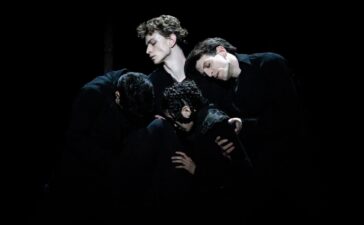
Presented once more at La Scala, this staging of the world-famous ballet builds a realm governed by order and protocol, while its capacity to move or unsettle the spectator remains limited.
by Alessandro Bizzotto
Far from a mere fairy tale, Rudolf Nureyev’s The Sleeping Beauty recasts the royal court as a finely tuned social organism. As I have noted in previous reviews, opulent spectacle here coexists with a psychological framework, though essentially superficial. This is a monumental vision of ballet in which every gesture is measured, and each tableau communicates hierarchy and authority. Nowhere is this more evident than in the prologue, where King Florestan asserts himself as a clearly absolute monarch, and the familiar narrative unfolds as a study in protocol. Nureyev’s choreography mirrors this precision: classical lines and symmetrical formations sit alongside moments of realism, characters both stylised and human, their ambitions and vulnerabilities legible in posture and port de bras, extending even to the master of ceremonies, who risks, quite literally, dramatic annihilation somewhere between prologue and Act One.
After roughly six years, this production returns to La Scala, Milan, in the staging designed by Oscar-winner Franca Squarciapino. Her work envelops the stage in facades suspended between Rococo and Neoclassical styles, featuring expansive windows. Unlike the Paris Opera’s version of Nureyev’s Sleeping Beauty, where Squarciapino contributed costumes only while the sets remained Ezio Frigerio’s, the Milanese revival adopts a different tonal register. The grandeur of the Parisian production – never merely decorative, airy and suffused with burnished golds and shimmering pastels – here tips into something far more garish and storybook-like. Consider, for instance, Aurora’s tutus in Acts One and Two which, rendered entirely in orange or lilac, curiously evoke, one might say, a plasticised, doll-like incarnation of the princess.

The baptism scene, which should establish the ballet’s moral and visual equilibrium, comes across here with a curious lack of focus. The entrance of the fairies, so carefully calibrated by Nureyev as an exercise in symmetry and collective precision, fails to coalesce into a legible image. Unison appears approximate and the carefully tiered hierarchy that should give the scene its crystalline clarity remains oddly blurred. At the centre of the ensemble, the principal fairy (soloist Maria Celeste Losa) does little to anchor the group: instead of projecting authority through line, her presence diffuses the eye, weakening the very geometry on which the scene depends. What should register as a moment of ritualised inevitability feels unexpectedly provisional, depriving the spectator of the sense of order that gives this prologue its theatrical force. The result is a moment that gestures towards grandeur without fully delivering it – a reminder that in this kind of architecture, authority is not a matter of costume or position, but of embodied clarity.
From the ritualised calm of the prologue, the ballet moves into the first act, where the famed Rose Adagio takes centre stage: it is here that a dancer’s mastery of balance becomes a conduit for grace and formal elegance.

I should confess, perhaps to my own fault, that having been utterly captivated by étoile Valentine Colasante’s Aurora in Paris last July, her serene authority lingers in my memory. So, seeing prima ballerina Alice Mariani’s Aurora at La Scala only a few months after Colasante’s imperious assumption of the same role inevitably places the spectator in a delicate position. Comparisons are rarely fair, and yet they are also unavoidable: memory, after all, is one of the silent forces that shape critical perception. I am not a neutral instrument, and Colasante’s serene grandeur, her luminous authority, remains vivid in the eye.
Mariani is undoubtedly a capable and intelligent performer. Her interpretation is musically attentive and grounded in a solid classical technique. Yet within Nureyev’s Rose Adagio — a passage whose demands remain constant regardless of venue or occasion — differences of emphasis inevitably surface. Where Colasante, in Paris, embodied control as a social and symbolic condition, Mariani approaches the role with a more cautious, carefully measured precision. The architecture of the Adagio holds, but it never quite crystallises, and the balances are negotiated rather than possessed.
This is not failure but a matter of degree. Mariani convinces as a young woman entering the rituals of courtly life; she is alert, poised, and attentive. What is missing is the extra composure that transforms technical command into emblematic authority.
That said, her performance has integrity. She avoids theatrical exaggeration and maintains a coherent stylistic line throughout. If her interpretation lacks the unshakeable calm that made Colasante’s so compelling, it compensates with a sincerity that speaks of potential rather than completion.
Perhaps the challenge lies precisely in Nureyev’s conception: the role is not merely a test of virtuosity, but a meditation on order and measured presence. To succeed, one must make effort appear effortless: balance must seem innate rather than achieved. Mariani comes close and, in fleeting moments, touches that ideal. That she does not fully claim it is not a fault to be condemned, merely a limitation made inevitable by the demands of the role.
Act Two is often described as the poetic heart of The Sleeping Beauty, yet its success depends on a paradox: Prince Désiré must command the stage precisely by seeming not to seek it. In Nureyev’s conception, the role belongs to a tradition that privileges inward suspension over outward declaration, an art of withheld energy in which longing is suggested rather than displayed.
At La Scala, this principle struggles to materialise. Navrin Turnbull’s Désiré is conscientious and visibly prepared, yet his presence tends to occupy space rather than shape it. The choreography develops cleanly, but without that subtle gravitational pull through which the prince’s interior life should begin to colour the stage.
By contrast, Alice Mariani’s Aurora unfolds with a wider breath and an enchanted presence; she is, after all, a vision, and she dances through the pas de deux with ethereal grace. Her balance in the Adagio has a sustained clarity of expression that Turnbull’s Désiré, precise though he may be, struggles to match in the delicate interplay of presence. This becomes most apparent in the vision scene, a passage that relies less on interaction than on atmosphere. When Aurora appears, the encounter is registered clearly, even dutifully, but it fails to disturb the prince’s equilibrium. The music swells, the image is there, yet the moment passes without imprinting itself on the spectator’s imagination. What should feel like an interruption of consciousness reads instead as a narrative necessity efficiently dispatched.
The issue is not theatrical excess. If anything, the opposite. Turnbull’s Désiré remains firmly literal, anchored to what is visible and immediate. But this prince requires a degree of opacity: a sense that something is withheld, unresolved, quietly burning beneath the surface. Here, that ambiguity never quite takes hold, and without it the act risks flattening into sequence rather than journey.

One is reminded how unforgiving this role can be. It does not reward assertion, nor does it announce its demands openly. Instead, it exposes the absence of charisma as gently as it exposes its presence. The result, in this instance, is an Act Two that functions smoothly yet leaves the audience less moved than patiently observant.
In Act Three, marking the wedding of Aurora and Désiré, the court is arrayed in all its finery, the divertissements flowing with polished precision, above all the playful interlude of the Bluebird and Princess Florine. Here, Saïd Ramos Ponce and soloist Gaia Andreanó lend the moment a delightful verve: light, precise, and buoyant, they briefly summon the sense of joy and elegance that the Milanese staging otherwise struggles to maintain. Notably, in this fleeting instance, Squarciapino’s costumes seem to gain an unexpected clarity and charm on the La Scala stage, their colours and lines more immediately persuasive than in Paris.
In the central pas de deux, Alice Mariani asserts herself with poise and a radiant, attentive musicality. Paired with Turnbull, the dynamic is curiously muted. His technically secure work lacks the responsive vitality one hopes for in these intimate passages, and the encounter reads more as formal alignment than as shared emotion.
The final tableau closes the ballet with its customary flourish, all colour, light and measured pageantry.
Unexpectedly, during the ensuing applause, La Scala’s general manager and artistic director, Fortunato Ortombina, takes to the stage alongside ballet director Frédéric Olivieri to announce Navrin Turnbull’s promotion to the rank of primo ballerino (first soloist, one step below principal or étoile – though in some countries the distinction between first soloist and principal is often blurred). The moment sparks murmurs of curiosity among the audience and excitement within the company, only to be sharply curtailed when Ortombina, mid-speech, cuts across with an abrupt “Shhh!”, silencing both whispering and anticipation alike.
It is Turnbull’s moved, brief words of thanks that bring the evening to its ceremonial close, providing a quietly human coda to the performance.