By Alice Heyward
Giselle: A Summary by theatre director Toshiki Okada, performed by Hana Sakai, was presented at Thalia Gaußstraße as part of Lessingtage 2026. The show was produced by Aichi Prefectural Art Theater and is part of the Constellation project, sponsored by the Japan Creator Support Fund.
creator.ntj.jac.go.jp/en/cultural-facilities/aichi-aac
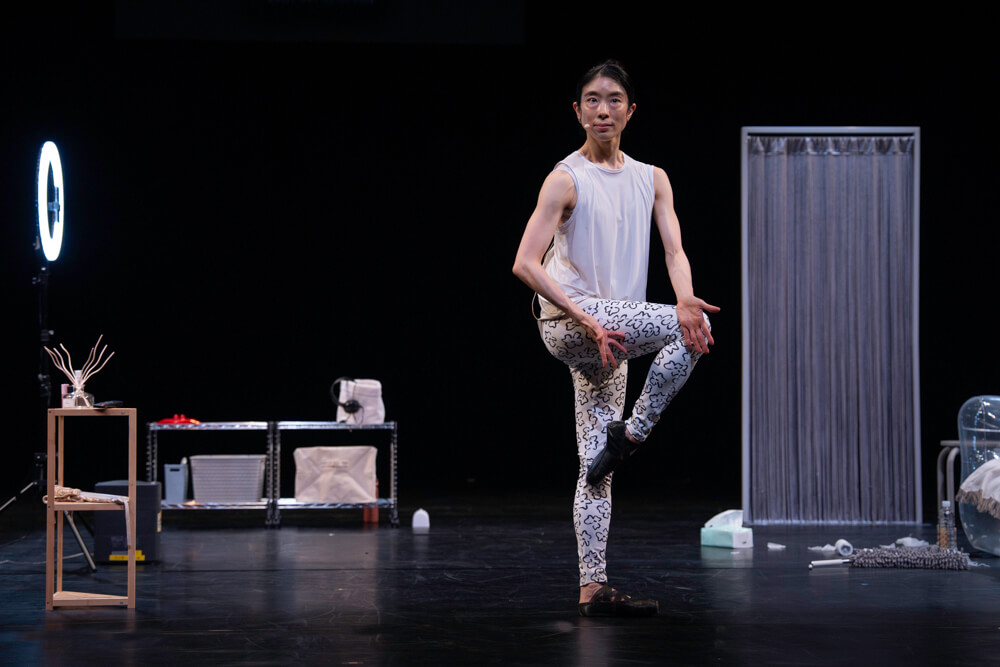
We file into Thalia Gaußstraße and sit facing an arrangement of domestic objects and low-fi production equipment. An inflatable sofa, plastic cabinetry, and a makeshift doorframe with white tassels create a border: a room. An essential oil diffuser pumps a light mist, functioning within the theatre as a bedroom-style smoke machine. The centrepiece of the space is a bright LED ring light aimed squarely toward stage right.
Hana Sakei, a Japanese former prima ballerina, enters the stage set-up wearing yoga tights and a white singlet and, charismatically, addresses the circular light, reframing the stage as a site of self-broadcast. From the seating bank, we have a perpendicular view onto the livestream shoot: voyeurs into another system of transmission. Sakei begins to tell the apparatus, in a TV-show-host style, complete with a warm grin, about her history as Giselle. The texture of her Japanese language flows from the monitors, and a screen flashes English subtitles. Speech is the work’s primary material, with ballet gestures peppering Sakei’s storytelling: a small arabesque here, a bourrée there. In this way, the “deconstruction” of ballet undertaken by director Toshiki Okada and Sakei occurs through the storytelling of Giselle, rather than through the reworking of ballet’s movement vocabulary. Classical ballet technique isn’t abstracted, but repositioned to become a spice in the story—a flair that elaborates a spoken narrative.
A “summary” is usually a concise version of something longer, highlighting essential information while excluding minor details and personal opinion. This “summary” of Giselle, narrated by Sakai, doesn’t offer an objective overview of the ballet; instead, it uses the story as a springboard for the soloist to share memories, anecdotes, and fantasies from the role she has performed many times. The “summary” we witness is of Sakei as Giselle. It traces the layered relationship between them across her career and within the microcosm of a single evening’s performance. The relationship between dancer and character is spotlit, illuminating how the performer becomes the construction of another figure, entwining ‘person’, ‘persona’, and ‘character’. Sakei portrays herself as a classical ballet dancer who returns to the same role again and again. Are we meeting Sakei, Giselle, or a new character that this show constructs? Does Sakei embody Giselle; does Giselle embody Sakei; or do they become each other—along with the many other dancers who perform Giselle across history and geography?


Sakei serves as an influencer, sharing her story with the online masses and building her presence through engaging content. This dispositif poses a twist, fragmenting our role as audience. We are in shared time and space with Sakei, watching her live performance together, anonymously, in a theatre. Her delivery is not livestreamed to dispersed viewers sitting alone with their devices, as the performance simulates. This juxtaposes contemporary culture with the arcana of the ‘original’ Giselle. Although no explicit position is taken on the proliferation of influencers, the artificial performativity in Sakei’s live demonstrations speaks volumes about the two-dimensionality of screen culture and its effect on our lives. Online performances are addressed to a machine—a fundamentally different receiver than a live, seated audience. Formulated to be shared and replicated, and without the direct energetic feedback of live presence, their purpose is to convince and sell (as) content rather than to produce a subjectively meaningful, embodied encounter. Sakei’s seamless slips into reenacted advertisements—abruptly cutting her story—highlight the performance of a self for online consumption, whether by describing how she left Giselle’s necklace in her dressing room during an interval and the ensuing drama, or by selling a product. What was said changed, not so much how. Sakei’s incredible skill as a performer lies in how she produces and rides the tension between representing the registration of a livestream performance and really performing live for us. We are a full house whose energetic attention and audible laughter come to her from her left periphery, not the symbolic camera in front of her.


Hana SAKAI × Toshiki OKADA „Giselle: A Summary“ by Aichi Prefectural Art Theater ©︎ HATORI Naoshi
Giselle: A summary’s curation in Lessingtage is the first time the show tours internationally. The world it conjures, as a foreign production, reminds us of the value and uniqueness of international live performance and theatre. Unlike experiences that can be uploaded or streamed online, performances must tour—or be locally reinterpreted—to be experienced internationally. Worldwide touring is part and parcel of the Internet itself, although highly censored in many authoritarian nations. As online audiences, we travel, surfing without moving an inch, consuming content that arrives on our screens, with algorithms predicting our endless wants, rendering us ever more passive consumers. As late-capitalist techno-political systems increasingly exercise control over time, bodies, and attention, this collaborative production leaves us to contemplate what remains in a story, a body, and a person through the recurring production of live and digital presence, projecting us back and forth through dimensions of time and space.
Sponsored Article